When you think of the author Lewis Carroll, you think of “Alice’s Adventures in Wonderland,” but it was the sequel, “Through the Looking-Glass,” that gave us “Jabberwocky,” one of the best and most recognized nonsensical poems of all time, which begins:
Twas brillig, and the slithy toves
Did gyre and gimble in the wabe;
All mimsy were the borogoves,
And the mome raths outgrabe.
But for all its silliness, “Jabberwocky” isn’t total nonsense, is it? It obeys English syntax and poetic form with its quatrains and ABAB rhyme scheme in iambic meter. Linguist Peter Lucas actually argued that calling it “nonsense” misses the point: It’s not without sense so much as a distortion of it. The words lean heavily on familiar sounds and etymological constructions, allowing the reader to conjure a story in their mind’s eye even when so many of the individual words don’t exist.
You might know, too, that Lewis Carroll didn’t really exist. The name was a pseudonym for Charles Lutwidge Dodgson, a Victorian mathematician, logician, photographer and reluctant Anglican deacon. Dodgson lectured on algebra and logic at Christ Church, Oxford, wrote treatises with titles like “The Game of Logic and Symbolic Logic,” and invented word puzzles — like the word ladder — that still show up in newspapers (where you can find newspapers) today.
But as Lewis Carroll, he built worlds where logic bent in on itself, full of riddles answered by more riddles. His made-up words served as the clues to navigating a mad wonderland. I’d argue “Alice’s Adventures in Wonderland” and “Through the Looking Glass” were really elaborate logic problems in disguise. And not least because they were rooted in the real world, as satires of Victorian authority wrapped in an absurd tea party.
In the context of Carroll/Dodgson’s meshing of fantasy and math, you could even think of “Jabberwocky” as less of a poem and more of a logic puzzle in verse. The words are like variables in an equation. The poem is solved rather than read. We plug meaning into the blanks the way a mathematician solves for x, until suddenly the whole story snaps into place.
Carroll once described his invented words as portmanteaus. “Slithy,” for example, combines “slimy” and “lithe.” Some of his coinages stuck so firmly that they no longer feel invented at all: “Chortle” and “galumph” both made their way into the Oxford English Dictionary. When Eric Malzkuhn invented a sign for “chortle” (for the line, “‘O frabjous day! Callooh! Callay!’ He chortled in his joy…”) it proved so popular it became part of American Sign Language’s permanent lexicon.
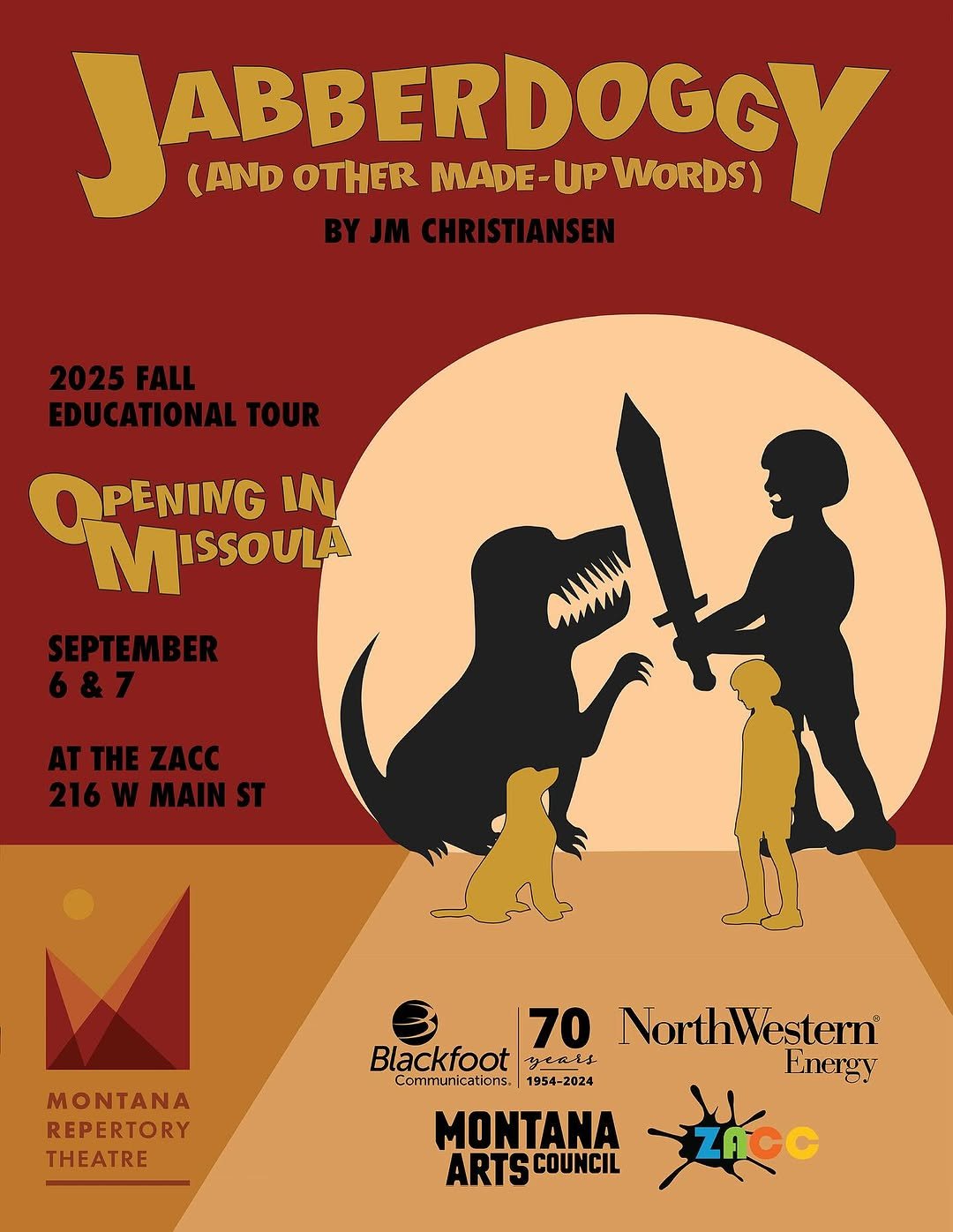
This weekend in Missoula, that logic of nonsense finds its way onstage in the play “Jabberdoggy (and other made-up words),” produced by Montana Repertory Theater. Written by Missoula playwright JM Christiansen and starring David X. Miller and Rory McLaverty, it will serve as the company’s production for its 2025 Fall Educational Tour.
The play follows a fictional high school club staging Carroll’s “Alice” stories. When one of the students, AJ, lands the role of the Jabberwock, learning the poem stirs up nightmarish memories. On opening night, an unlikely friendship and a hardship from his past lead AJ to a revelation about the strange ways words can give shape to fear, and how fear, in turn, can reshape the stories we tell ourselves.
My love for Montana Rep keeps growing all the time for how it considers its audiences. For the past few years, the professional theater company that resides at the University of Montana has been experimenting with new works in unusual locations, generally for adults. “Jabberdoggy” is family-friendly theater that I can almost guarantee without seeing it yet, isn’t toothless.
That was Carroll’s approach to audience as well. His stories show that words create monsters — and slay them, too. That the story you tell yourself might not be real, but a jabberwocky in disguise. And regardless of some deeper meaning, who doesn’t want to indulge in a story full of fun words like “slithy toves” where a burbling creature whiffles through a forest full of bandersnatches and Jubjub birds — pursued by a slaying hero with a vorpal blade that goes snicker-snack?
—Erika Fredrickson
FEATURED EVENT
Montana Rep’s ‘Jabberdoggy (and other made-up words)’
Sat., Sept. 6, at 2 PM and 7:30 PM and Sun., Sept. 7, at 2 PM (doors open a half hour before each show) @ The ZACC. Pick-What-You-Pay: Adult suggested $20 / Youth suggested $10 / Kids 5 and under free. All ages.
Speaking of words that slay, Tom Catmull writes powerful songs with sharp lyrics, and has been playing them in coffee shops, galleries, breweries, and in recording sessions for years. His lyrics are grounded in familiar images but capable of small turns that can wound you (or elate you). In one of his older songs, “Blue,” he sings, "If it wasn’t for the clear sky of the deep / see the wild yonder / I wouldn’t be feeling so alone … say the word / say to me / are you blue, like a tree?" It’s not nonsense in the Carrollian sense exactly, but it bends expectation in a way that defies the ordinary but reveals truths all the same. Am I trying to make a case that poetry is just algebra at its core? I guess so. (Also: Catmull released new music this year, too.) Catmull plays the Missoula Art Museum’s First Friday party this week, which is a kickoff to “Member September,” a monthlong celebration of MAM members as well as a membership drive. You can explore MAM’s latest exhibitions, including “Rearranging Stars,” a collective exhibit of experimental quilts by artists Jennifer Leutzinger, Delia Touché, and Brittney Denham Whisonant, who drew on the deep history of star quilts. Star quilts were introduced to the Fort Peck Reservation by missionaries in the 1800s and adapted by Native women — as buffalo robes disappeared — to create a visual language of survival and connection. And because star quilts are a kind of cross-cultural language, each artist has used their own style to turn the star into both a point of connection and a point of departure. Because it’s MAM’s 50th anniversary, the first 50 people to become members during the event will receive a complimentary limited-edition gift bag worth $60 and all new and renewing members will also be entered into a raffle.
If you’ve ever wanted to see hurling in action, but not the kind your college roommate did after a night of bar hopping, the Fáilte Montana Irish Festival is the place to be. Hurling is one of the world’s oldest and fastest field games — a mash-up of hockey, lacrosse and baseball, but Irish. Players use a curved stick called a hurley to launch a small ball, the sliotar, across the field, aiming for points over the crossbar or goals under it. Besides hurling demos, the festival includes multiple Irish bands with headliner Waters & Bays Irish Fiddles featuring Clint Dye on the guitar, as well as Irish dancers, local food and drink and arts and craft vendors. This festival is a celebration of culture, but also a way to bring awareness to the University of Montana’s Irish Studies program and the opportunities provided by the Friends of Irish Studies in the West. You can go to the party whether you’re proudly Irish or, you know, "Irish-curious.” —Quinn Stromberg
Fri., Sept. 5, from 2:30 PM to 9:30 PM @ Caras Park
First Friday at the Montana Museum of Art & Culture
The Montana Museum of Art & Culture has been part of Missoula almost as long as the University of Montana has existed. For many years, it was kind of tucked away, but in 2023, a shiny new state-of-the-art building was opened to house its collection and provide much more prominent exhibition space. MMAC kicks off the fall semester with its first First Friday event of the year, which includes a “19 under 39” exhibit celebrating emerging Montana artists, an homage to artist Kristi Hager, and selections from the permanent collection. You can wander the exhibits, nibble on some small appetizers, and chat with other art lovers in that sort of low-key but cultured way we get to do in this arty town. —Quinn Stromberg
Indigenous contemporary artists are 'rewriting the rules'
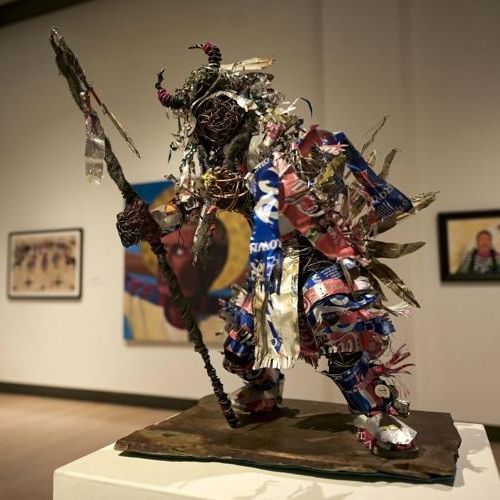
The new Missoula Art Museum exhibition, “Good Relations: Contemporary Native Artists in the MAM Collection,” serves as an introduction to the myriad avenues Indigenous artists have been exploring for the past several decades.
Missoulian
Now you can bike, hike — and even ski — through the new Wild West of art
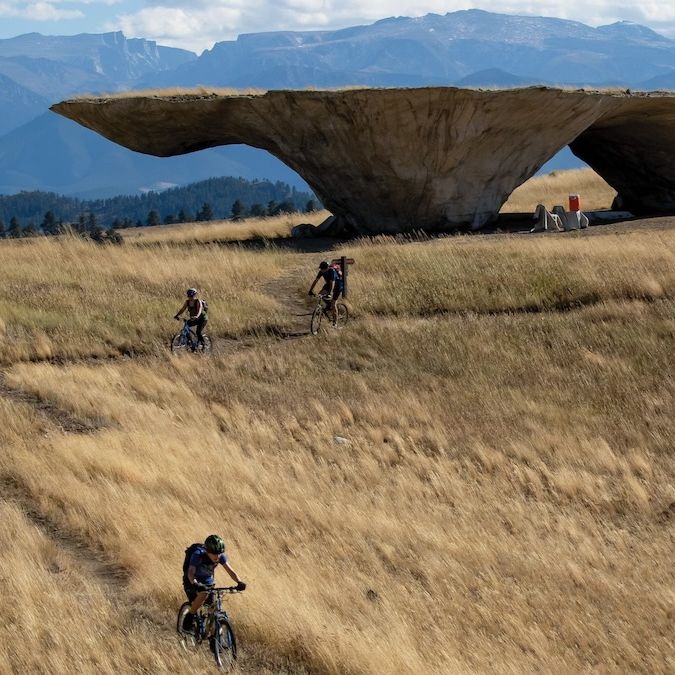
From Montana’s sprawling sculpture park to Utah’s skiable museum, land art is having a moment in the American West — and it’s more accessible (and adventurous) than ever.
Climate petition denied by Montana Public Service Commission
In a decision that drew immediate pushback, the PSC voted unanimously Tuesday against declaring the constitution requires it to consider the adverse impacts of climate change in its work.